

Tesla Wall Connector installation Enid: Cost, Wiring, and Choice
⏱️ 8 min read · Last updated: 2026
- Typical install cost: commonly about $800 to $2,500 in Enid, OK, with panel upgrades pushing some jobs higher.
- Recommended circuit size: a 60-amp breaker on a 240V circuit is the common Tesla Wall Connector setup for home charging.
- Wiring gauge: 6 AWG copper is the usual choice for a 60-amp run when the installer follows Tesla wall connector wiring guidance and NEC 625.
- Typical install time: about 3 to 6 hours for a straightforward hardwired install; longer if the panel is full or the run is long.
- Charging choice: a NEMA 14-50 outlet is often easier to replace later, but a hardwired install is usually the sturdier long-term option.
A garage charging quote can look small until the electrician opens the panel and finds only one free breaker slot. That is where Tesla Wall Connector installation Enid turns from a neat accessory job into a real electrical decision. I have seen clean installs finish in half a day, and I have seen “simple” quotes grow once the run had to cross a finished attic or a crowded main panel.
The trade-off is pretty straightforward: pay less now with a plug-in setup, or pay for the cleaner, more permanent setup once. In 2026, that choice matters more than people expect because the difference is not just the charger itself. It is panel capacity, wire length, local permit handling, and whether the installer can give you a true 240V circuit setup without compromising the rest of the house.
One practical note from working through these setups: the fastest installs were not the cheapest ones. The fastest jobs had short wire runs, enough panel space, and a homeowner who had already checked where the Tesla Wall Connector would live on the wall.
What really changes the answer
If your panel has room, the wall location is close to the panel, and you want the most durable daily setup, Tesla Wall Connector installation Enid usually points to a hardwired install. If your panel is cramped or you want a lower-cost option that can move later, a NEMA 14-50 outlet may be the better first step.
The part people miss is load calculation. Under NEC 625, an EV charging circuit is treated as a continuous load, so the circuit is sized with margin instead of just “whatever the charger can physically pull.” In real homes, that means a 60-amp breaker is common for the Tesla Wall Connector, but the actual charging current is often set lower to match the home’s available capacity.
Another local factor is house age. Many Enid homes can support a Level 2 charger with no drama, but older panels, detached garages, and longer conduit runs change both labor and price. The electrician is not just mounting a box; they are deciding whether the load belongs on the main panel, a subpanel, or a new feeder.
A Tesla Wall Connector is only as good as the circuit behind it; the charger matters less than the panel capacity and wire path feeding it.
Use this table to decide fast
| Situation | Best Path | Why Other Options Fail |
|---|---|---|
| Garage wall is near the panel | Hardwired install | Lower voltage drop, fewer failure points, cleaner long-term setup |
| You may move soon | NEMA 14-50 outlet | A hardwired unit is less convenient to remove and relocate |
| Panel is nearly full | Load review first | Guessing can force an expensive rework or a breaker that should not have been added |
| You want the simplest long-term daily charging | Tesla Wall Connector hardwired | Plugs wear, receptacles heat up, and loose connections become the weak point |
Quick check: If your garage wall is within a reasonable conduit run of the panel and you plan to stay put, hardwired is probably the right answer.

Should I hardwire my Tesla Wall Connector or use a NEMA 14-50 outlet in Enid?
For most homeowners, hardwire wins if the Tesla Wall Connector will stay in one place and charge every day. A NEMA 14-50 outlet makes sense when flexibility matters more than permanence, or when you want a cheaper first step while you learn how much charging you actually need.
The reason hardwire is usually my lean is simple: fewer moving parts. A plug-and-receptacle setup adds one more connection that can loosen, wear, or discolor over time, especially if it is used hard. That does not mean a NEMA 14-50 outlet is bad; it means it is better when you need portability or a lower entry cost.
For Tesla wall connector wiring, many electricians will still use a 60-amp breaker on a 240V circuit for a hardwired install, while a NEMA 14-50 outlet is commonly protected differently depending on the charger and code requirements. If you want the charging setup that feels most like a built-in appliance, hardwire usually delivers that.
A hardwired Tesla Wall Connector is the better long-term fit for most single-location garage installs, while a NEMA 14-50 outlet is the better move only when flexibility or resale matters.
- Check whether you plan to keep the charger in one place for at least 2 to 3 years.
- Look at the main panel and count free breaker space, not just free wall space.
- Estimate wire distance from panel to charger location; long runs raise labor and material costs.
- Decide whether you need removable charging or a fixed home base.
- Ask the electrician to price both the hardwired install and the NEMA 14-50 outlet.
- Choose the option that fits your real habits, not the cheapest line item.
For many households, the deciding factor is not the Tesla Wall Connector itself; it is how often you will use it and whether a plug-in solution creates extra failure points. If you rent, there is also a separate planning path for EV charger installation apartment rental Enid because permission and reversibility matter more than in a detached home.
Quick check: If you are still deciding whether the charger will stay in one house, start with the NEMA 14-50 conversation; if not, hardwire is usually the better call.
How the install actually happens
The install is straightforward when the panel is accessible and the charger location is close. It gets slower when the electrician has to snake conduit through finished spaces, upgrade the panel, or add a subpanel first.
A normal hardwired install usually follows a clean sequence. In my experience, the jobs that finished on time were the ones where the homeowner had already cleared the garage wall and confirmed the charger height before the electrician arrived.
- Verify the panel can support the added load under NEC 625.
- Choose the charger location and confirm cable route, wall height, and mounting clearance.
- Pull the permit if the city requires one for the electrical work; if you are unsure, check the EV charger permit Enid OK details before the install starts.
- Run the correct conductors for the circuit, commonly 6 AWG copper for a 60-amp setup, or the size your electrician specifies after load review.
- Mount the Tesla Wall Connector and terminate the wiring in the unit for a hardwired install.
- Test voltage, breaker operation, and charging current before calling the job complete.
The actual wall-mount part is the fast step. The time sink is almost always the circuit path. A 15-foot run on an open wall can be a very different job from a 50-foot run through attic space or a detached garage feeder.
One practical detail that saves time: mark where your car actually parks. Many homeowners mount the charger too far forward or too close to the garage door track, then end up with a cable that is awkward on day one. That mistake is easy to avoid and annoying to fix.
If you want a broader look at charger styles and home layouts, the EV charger installation Enid OK page is useful for comparing setup types before you commit to a location.
Quick check: If your garage wall is ready, the panel is accessible, and the route is short, your install should feel like a half-day project rather than a remodel.
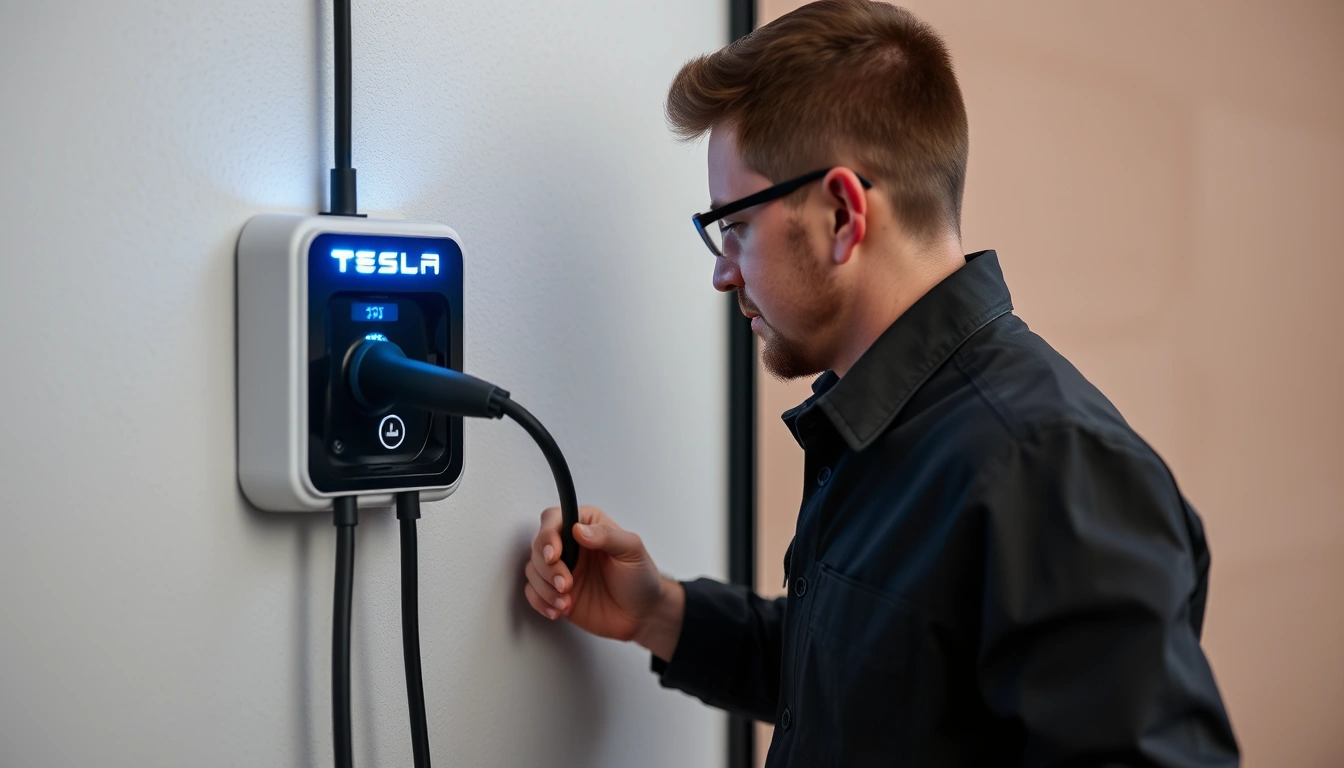
How much does it cost to install a Tesla Wall Connector in Enid, Oklahoma?
How much does it cost to install a Tesla Wall Connector in Enid, Oklahoma? In most cases, expect roughly $800 to $2,500 for a typical home install, with the low end covering simple labor and materials and the high end covering longer runs, panel work, or a permit-heavy job.
The biggest price drivers are not mysterious. They are labor hours, conductor length, breaker space, and whether the home needs a panel upgrade. A tidy install near the panel may land near the lower end, while detached garages and older electrical systems can raise the number fast.
Compared with a NEMA 14-50 outlet, a hardwired Tesla Wall Connector often costs a bit more to install but less to worry about later. If you want a deeper breakdown of the price pieces, the level 2 EV charger installation cost Enid OK article is where the labor and material ranges are broken out more cleanly.
A typical Enid homeowner pays more for wire length and panel conditions than for the Tesla Wall Connector hardware itself.
Permit rules can also shape the bill. If a permit or inspection is required, the electrician may include admin time, inspection coordination, or a return trip. That is normal. It is also why two quotes that look similar on paper can end up very different once the job is scheduled.
For current code language and EV charging equipment guidance, the Tesla Wall Connector support page and the NFPA site are better references than random forum posts. I also keep the U.S. Department of Energy’s Alternative Fuels Data Center bookmarked when I need a neutral overview of home EV charging basics.
Quick check: If your quote is way below $800 or way above $2,500, ask what the electrician included before you compare it to anything else.
When the standard advice is wrong
The standard advice breaks down when your panel is old, your garage is detached, your parking spot is awkward, or you rent the home. In those cases, the right answer is not “just install the charger”; it is “solve the electrical path first.”
Here are the edge cases that change the plan.
Detached garage
If the Tesla Wall Connector is going into a detached garage, the answer usually changes from simple branch circuit work to a feeder or subpanel discussion. The wiring path gets longer, the labor gets higher, and voltage drop matters more. In that case, a hardwired install still makes sense, but the route and protection device need more attention.
Full main panel
If the main panel has no room, the electrician may recommend a subpanel, a load calculation, or a service upgrade instead of forcing the charger into a crowded box. That changes the budget more than any charger brand choice. It also changes the timeline from a same-day install to a multi-step project.
Rental or future move
If you may move in the next year or two, a NEMA 14-50 outlet can be the better compromise because it is easier to leave behind or adapt. That is why charger installation apartment planning matters so much in temporary housing situations.
Long cable route
If the charger is far from the panel, the cost is often driven by copper length and labor, not by the Wall Connector itself. In 2026 copper pricing still makes long runs noticeable, so the electrician may suggest moving the charger location a few feet to cut several hundred dollars from the job.
Existing 240V outlet already in the garage
If you already have a 240V circuit setup in the garage, the conversation changes again. Sometimes the existing circuit can be reused after a load check and a receptacle review, but sometimes it is undersized or tied to the wrong breaker type. Do not assume the old outlet is EV-ready just because it is 240V.
I made this mistake once on a different property: assuming the “spare” garage circuit was ready for a charger because the outlet looked sturdy. It was not sized for the continuous load, and the quote got cheaper only after the electrician confirmed what had to be rebuilt. That lesson was expensive, but it saved a worse problem later.
Quick check: If your situation includes a detached garage, a full panel, or rental rules, start with the electrical path instead of the charger model.
Common questions about Tesla Wall Connector installation Enid
These are the questions that come up most often when people are trying to choose between speed, cost, and permanence. The short answers matter because the wrong setup can be annoying every single day.
What is needed to install a Tesla Wall Connector at home?
You need a dedicated 240V circuit, a breaker sized for the load, the correct wire gauge, and enough panel capacity for a continuous EV charging load. For many homes, that means a 60-amp breaker and 6 AWG copper wire, plus a permit if local rules require one.
How to install a Tesla Wall Connector in Enid step by step?
Start with a load check, choose the charger location, confirm the wire route, pull the permit if needed, run the 240V circuit, mount the Tesla Wall Connector, and test the system. A clean install usually takes 3 to 6 hours if the panel is ready.
Tesla Wall Connector vs NEMA 14-50 — which is better?
A hardwired Tesla Wall Connector is better for a fixed home base, daily use, and fewer connection points. A NEMA 14-50 outlet is better if you want flexibility, a lower initial cost, or a setup you may change later. Most long-term homeowners prefer the hardwired option.
Why is my Tesla Wall Connector not charging at full speed?
The most common reasons are a breaker that is undersized, a charger setting that was limited during setup, or a circuit that cannot support the full amperage. Check the breaker size, the installation settings, and whether the panel is sharing capacity with other large loads.
How much does Tesla Wall Connector installation cost in Enid?
Most Enid homeowners should expect roughly $800 to $2,500 for a standard install. The biggest variables are wire distance, panel condition, permit work, and whether the job needs a panel upgrade or a detached-garage run.
- For most homes, Tesla Wall Connector installation Enid works best as a hardwired 240V circuit setup.
- A 60-amp breaker and 6 AWG copper wire are the common home-install baseline in 2026.
- Expect about 3 to 6 hours for a straightforward install, longer if the panel or garage layout is complicated.
- A NEMA 14-50 outlet is the flexibility play; a hardwired install is the permanence play.
The bottom line
Tesla Wall Connector installation Enid is worth doing right the first time if you plan to keep the car, park in the same spot, and charge at home most nights. My take: choose the hardwired route unless you have a strong reason to stay portable, because the daily convenience and lower maintenance usually beat the small savings from a plug-in shortcut.
Pick one thing from this article and try it this week, not all of it, just one: photograph your panel, measure the wall-to-panel distance, or ask for two quotes that separate labor from materials. If you want the bigger picture on charger types, permits, and cost planning, the pillar page on EV Charger Installation in Enid, OK: Level 2 Cost, Permits & Which Charger Fits Your Home is the right next stop.
See also: EV charger installation Enid OK
See also: level 2 EV charger installation cost Enid OK
See also: EV charger installation apartment rental Enid
Related: best EV charger for Enid home
Related: NEMA 14-50 outlet installation Enid
Related: EV charger installation time process Enid

Leave a Reply