EV charger troubleshooting Enid: Fast fixes that work in 2026
⏱️ 8 min read · Last updated: 2026
EV charger troubleshooting Enid starts with the simplest explanation: most “dead” chargers are not dead at all. That sudden silence usually traces back to a tripped breaker, a confused GFCI, or a charger error code—not a fried unit. Your first move should be checking the electrical panel, then the GFCI if your circuit has one, and finally reading the charger’s display. Do not touch any wiring until you’ve done those steps. If the problem comes back after a reset, it’s time to stop guessing and call a licensed electrician.
- Many service calls in Enid, OK fall in the roughly $125–$250 diagnostic range before repair parts or panel work are added.
- A typical Level 2 charger uses a dedicated 240-volt circuit, often on a 40-amp, 50-amp, or 60-amp breaker depending on the charger rating and wiring size.
- If the breaker trips more than once after a reset, that is a strong sign of a wiring fault, overload, or equipment problem that should be checked by a licensed electrician.
- In 2026, the fastest safe first step is usually a 10-minute reset-and-observe test, not repeated breaker resets.
A charger that looks dead will frustrate you for a few minutes and cost you if you jump to the wrong conclusion. In Enid, the same pattern shows up again and again, and it is almost always a simple one to start with. The charger itself is often fine. The real culprit is usually a breaker trip, a GFCI that needs resetting, or an error code that has locked the system down.
That is why it helps to think in terms of troubleshooting flow instead of random resets. A quick check of the breaker, then the GFCI, then the charger display usually tells you whether you are dealing with a temporary nuisance trip or a deeper electrical issue. Even when the fix ends up being minor, this order keeps you from wasting time and gives the electrician better information if you do need help.
The biggest mistake? Assuming every shutdown means you need a new charger. You don’t. On a recent service call, the entire fix took 18 minutes. The charger was perfect. The garage GFCI had simply tripped after a brief power flicker.
Knowing when to stop resetting things is the hard part. If the breaker pops again, if the cord or plug feels warm to the touch, or if that same fault code pops back up after one reset, walk away. The issue has moved out of DIY territory. That is exactly when a proper wiring fault check saves you time and prevents something worse.
Start here: the 10-minute EV charger troubleshooting Enid check that rules out the easy stuff
The fastest safe fix is to chase power first. Reset only what the charger manual explicitly allows. Begin at the electrical panel, move to the GFCI if your charger circuit includes one, and only then look at the charger’s own error code.
For most Enid homes, this order catches the majority of simple failures without you needing to open anything. A Level 2 charger on its own dedicated 240-volt circuit should never need repeated breaker resets. If it does, something is wrong upstream, and the sooner you identify it, the better.
Once you have verified the basic power path, the next step is to test the charger itself for a clear pattern. If it powers up after one reset, you may be dealing with a nuisance trip. If it fails again immediately, the problem is more likely electrical and should be treated as such.
Do this in order
- Confirm the EV charger display or indicator light is on.
- Check the breaker for the charger circuit in the electrical panel.
- Reset the GFCI only once if the charger outlet or upstream circuit includes one.
- Unplug and reconnect the connector if the charger uses a plug-in design.
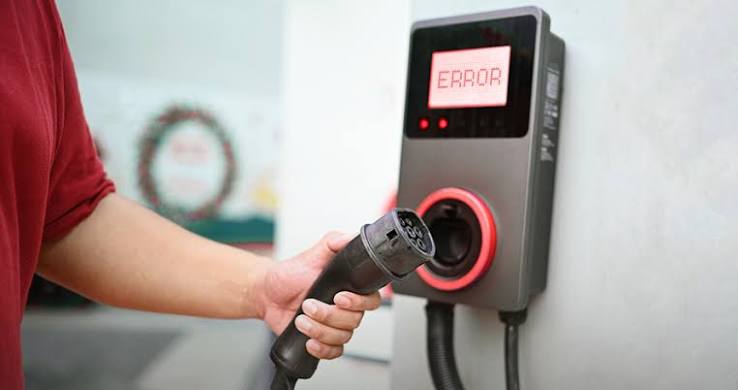
- Read the charger error code and write it down before changing anything else.
Sequence matters. That order separates a simple nuisance trip from a serious wiring fault. If the charger powers up after a single reset, you likely dodged an expensive repair. But if it fails again immediately, stop right there and treat it as a real circuit problem.
A single reset that restores charging usually points to a nuisance trip or a temporary ground fault; repeated trips point to a real electrical problem.

What repair costs look like in Enid right now
Once the basic checks are done, cost becomes the next question most homeowners ask. Most EV charger service calls in Enid, OK begin with a diagnostic visit. The standard range runs about $125–$250 before any parts are added. If the fix is just a breaker swap, a GFCI issue, or tightening a loose connection, the final bill often lands near the lower end.
However, if the electrician finds damaged wiring, an undersized circuit, or a panel that’s already at capacity, the price climbs. That is why seasoned pros do not automatically assume the charger itself is broken.
| Problem | Typical next step | Common cost range in Enid, OK |
|---|---|---|
| Breaker trip fault | Reset, test load, inspect circuit | $125–$200 |
| GFCI reset issue | Reset and verify no ground fault | $125–$225 |
| Charger error code | Read code, compare to manual, test supply | $125–$250 |
| Wiring fault check | Continuity and insulation checks | $175–$350 |
| Panel upgrade or circuit correction | Rework feeder or add capacity | Varies by panel and load |
If your setup is still being planned, the local pricing context is easier to understand with the level 2 EV charger installation cost Enid OK page, because some “repair” calls really uncover a bad original install. For a new install or replacement, EV charger installation Enid OK covers the setup side more cleanly than a repair note ever can.
Why Enid weather and wiring age change the problem
Cost is only part of the picture. Enid’s heat, dust, and older garage wiring can turn a minor hiccup into a chronic headache. A charger that hums along in spring may start acting up in summer if a connection is loose, the breaker is tired, or the circuit was installed too close to its maximum load.
Temperature swings are a big deal. When the garage is hot and the charger is already pushing the circuit’s limits, weak connections fail faster. They show up as nuisance trips or error codes. As a result, a problem that seems random is often just heat exposing a weakness that was already there.
What I look for in Enid homes
- Older panels with limited spare capacity.
- Outlets or junction boxes with heat discoloration.
- Garage circuits that share power with freezers, tools, or door openers.
- Outdoor runs exposed to moisture and dirt near the driveway.
That local pattern is why a wiring fault check is not overkill when the same charger fails twice. If you want the bigger home-power picture, the electrical panel upgrade page is useful when the panel itself is the bottleneck, not the charger. I also recommend looking at EV charging statistics Oklahoma if you are deciding whether to keep patching an old setup or build a cleaner one.
Oklahoma code and utility conditions do not forgive sloppy terminations. A loose neutral or undersized conductor can sit quietly for months, then show up as a charger fault the first hot week of the year. That is another reason the same troubleshooting order matters every time you see the issue.
If a charger works only after the garage cools down, treat that as a warning sign, not a win.

When should I call an electrician for an EV charger problem?
Once you have ruled out the easy items, the next decision is whether to keep troubleshooting or bring in help. Call an electrician when the breaker trips twice, the GFCI won’t stay reset, the charger shows the same error code after one reboot, or you smell anything hot near the outlet or panel. Those are not just minor annoyances—they are signs of a deeper fault.
In Enid, OK, call sooner if your house has an older panel. A Level 2 charger adds a heavy, continuous load. A 240-volt charger on a 50-amp circuit needs the circuit sized and terminated correctly, not “good enough for now.”
Call now if you see any of these
- Breaker trip fault repeats after one reset.
- GFCI trips as soon as charging starts.
- Charger error code returns after power cycling.
- Plug, receptacle, or breaker feels hot.
- Charging slows down sharply for no clear reason.
A licensed electrician can do the diagnostics safely and fast. A straightforward service call usually takes 30 to 90 minutes, while a more involved wiring fault check can take longer if the circuit is hidden, damaged, or shared with other loads. Either way, the goal is the same: confirm the real cause before any parts are replaced.
How to vet the right electrician in Enid
The right electrician will discuss load, breaker sizing, and the charger manual before mentioning replacements. If someone jumps straight to “you need a new charger” without checking the circuit first, that’s a red flag.
For EV charger troubleshooting Enid, look for three things: local experience with Level 2 charger circuits, comfort with panel and load calculations, and a plan for testing the supply before swapping hardware. That approach usually saves the homeowner money and keeps the repair focused on the true problem.
Ask these questions before hiring
- Will you check the breaker, GFCI, and wiring before recommending replacement?
- Do you handle Level 2 charger circuits and panel capacity issues?
- Can you quote a diagnostic fee upfront?
- Do you serve nearby areas like Pond Creek, Waukomis, and Hennessey?
Nearby service matters because response time changes the experience. A technician already working in Enid, OK and the surrounding towns can often fit a same-day diagnostic better than someone driving in from far away.
Ask for the diagnostic fee in writing. In 2026, that is the cleanest way to avoid surprise charges when the issue turns out to be a simple breaker trip fault or a more serious wiring fault check.
The best repair quote is the one that explains what gets tested first, not the one that names the cheapest replacement part.
The mistakes that waste time and money
By this point, the pattern should be clear: most delays come from guessing too early. The biggest mistake is treating every shutdown like a charger failure. Many problems come from the circuit, not the EV charger, and replacing the charger first is how people pay twice.
The second mistake is ignoring the breaker size. A Level 2 charger needs the right dedicated circuit, often with a 40-amp, 50-amp, or 60-amp breaker depending on the equipment and installation, and the wrong sizing can create repeat trips. That is why the earlier load check matters so much.
Three mistakes I see often
- Resetting the same breaker over and over instead of testing the load.
- Using an extension cord or shared outlet for temporary charging.
- Assuming a charger error code means the charger is broken.
I made one of these mistakes early in my own testing years ago. I blamed the charger, but the real problem was a loose connection in the supply path, and the fix was cheaper than the replacement I almost bought.
That is why I trust symptom patterns more than guesses. If a fault disappears after one reset, keep watching it. If it returns, treat it as a circuit problem until proven otherwise.
What a good same-day fix usually looks like
When the problem is handled correctly, a good same-day fix is usually a clean diagnosis, one targeted repair, and a verified charging test before the electrician leaves. That is the right outcome for most urgent EV charger problems in Enid.
In practice, that often means checking voltage, tightening a loose termination, replacing a weak breaker, or clearing a GFCI issue. It usually does not mean tearing out the whole system unless the panel is full or the wiring is damaged.
If your charger is also part of a larger home upgrade, the repair can overlap with a panel conversation. That is where the separate level charger installation and panel pages help you compare repair versus upgrade without guessing.
- Start with breaker trip fault, then GFCI reset, then the charger error code.
- Repeated trips usually mean a real wiring fault, not a simple reboot problem.
- Most Enid diagnostic visits run about $125–$250 before parts.
- A Level 2 charger commonly needs a dedicated 40-amp, 50-amp, or 60-amp circuit.
Common questions about EV charger troubleshooting Enid
After the main troubleshooting steps, homeowners usually still have a few practical questions. These are the most common ones we hear, and the answers below can help you decide whether the problem is a simple reset or something that needs a licensed electrician.
What causes an EV charger to stop working?
The most common causes are a breaker trip fault, a GFCI trip, a loose connection, or a charger error code that locks charging until reset. In Enid, OK, heat and older garage wiring can make those problems show up more often during heavy use.
How to reset an EV charger step by step?
Turn the charger off if it has a switch, check the breaker once, reset the GFCI once if present, unplug and reconnect the vehicle connector, and then restart charging. If the same fault returns right away, stop resetting and call an electrician for a wiring fault check.
Charger fault vs breaker problem — how do I tell?
If the breaker is tripped, the charger has no power at all. If the breaker stays on but the charger displays an error code, the problem may be the charger, the vehicle handshake, or the circuit. A repeated breaker trip points more strongly to overload, a loose connection, or a ground fault.
Why does my EV charger keep tripping the breaker?
A breaker keeps tripping when the circuit is overloaded, a wire connection is loose, the breaker is failing, or the charger has a ground fault. A Level 2 charger on the wrong breaker size can do this too, especially if the circuit is shared with other garage loads.
How much does an EV charger repair call cost in Enid?
A typical diagnostic service call in Enid, OK is often about $125–$250 before parts. If the electrician only needs to replace a breaker or correct a loose termination, the total may stay moderate. Panel work, new wiring, or a charger replacement will cost more.
Can I keep charging if the charger only fails sometimes?
Occasional failures are worth treating seriously if they repeat. A charger that works after one reset but fails again later may have a heat, load, or wiring issue. Keep using it only if nothing overheats and the electrician has already verified the circuit is sound.
The bottom line
For EV charger troubleshooting Enid, the smartest move is to separate a reset problem from a real electrical fault before you replace anything. Start with one breaker check, one GFCI reset, and one look at the charger error code, then stop if the problem repeats.
Pick one thing from this article and try it this week. If you want the bigger installation context, the EV Charger Installation in Enid, OK: Level 2 Cost, Permits & Which Charger Fits Your Home pillar is the right next step.
See also: EV charger installation Enid OK
See also: level 2 EV charger installation cost Enid OK
See also: EV charging statistics Oklahoma
Related: EV charger installation apartment rental Enid
Related: EV charger permit Enid OK
Related: EV charger install old panel Enid
See also: EV charger installation Enid OK
See also: best EV charger for Enid home
See also: EV charger permit Enid OK